Rugby can look like a wall of shoulders and noise, but it runs on a small set of ideas that repeat over and over. Learn those ideas and the noise turns into a game. That is what this is: a fifteen-minute start.
You do not need to memorise a rulebook. You need to know how points arrive, who stands where, and why the referee keeps blowing the whistle. Everything else you pick up just by watching.
Start With How Points Happen
Almost every match is decided by four scoring methods, and they are worth remembering as a set.
- Try — 5 points. A player carries the ball into the opponent's in-goal area and touches it down on the ground. This is rugby's version of a touchdown, and it is the goal of almost every attack.
- Conversion — 2 points. After a try, a kicker takes a place kick from directly behind where the ball was grounded. Send it between the posts and the try is worth seven in total.
- Penalty goal — 3 points. After a penalty, a team can choose to kick at the posts from where the offence happened. Three points, no try needed.
- Drop goal — 3 points. A player drops the ball and kicks it through the posts during open play. Rare, and correspondingly exciting.
That gives you a quick way to read the scoreboard. Five is a try nobody converted. Seven is a converted try. Three is a kick. Noticing this alone keeps you oriented as the match swings.
One detail worth catching early: where the try is scored matters. A try under the posts leaves a simple conversion. A try in the corner leaves a hard one, kicked from an angle. Watch teams fight to score closer to the middle, and watch how much easier those kicks look.
The Positions, In Plain Terms
In rugby union, fifteen players start per team. They split into forwards and backs, and the jersey number tells you the role. Numbers 1 to 8 are forwards, 9 to 15 are backs.
Forwards do the close, physical work: scrums, lineouts, rucks, and carrying the ball into contact. Backs generally operate in more space, though the modern game blurs this constantly.
- 1 and 3, props; 2, hooker: the front row of the scrum. The hooker also throws the ball in at lineouts.
- 4 and 5, locks: the tall jumpers lifted high in the lineout.
- 6 and 7, flankers; 8, number eight: the back row. Often the busiest tacklers and carriers on the pitch.
- 9, scrum-half: passes the ball away from rucks and directs the tempo.
- 10, fly-half: usually the main decision-maker and tactical kicker. If you want to know what a team is trying to do next, watch the 10.
- 12 and 13, centres: the midfield runners and defenders.
- 11 and 14, wings: the fastest finishers, often waiting out wide for the final pass.
- 15, fullback: the last line of defence and a frequent counter-attacker.
Rugby league runs on the same idea with thirteen players per side and a different tackle count. The scoring and tackling basics still apply, so the rest of this holds up either way.
Ruck, Maul, and the Rules You Actually Notice
Four laws explain most of what stops and starts a match.
The pass must go backward. A pass thrown forward hands possession to the other team. Players throw flat, fast passes that look forward from the stands. They are not — trust the referee, not the camera angle.
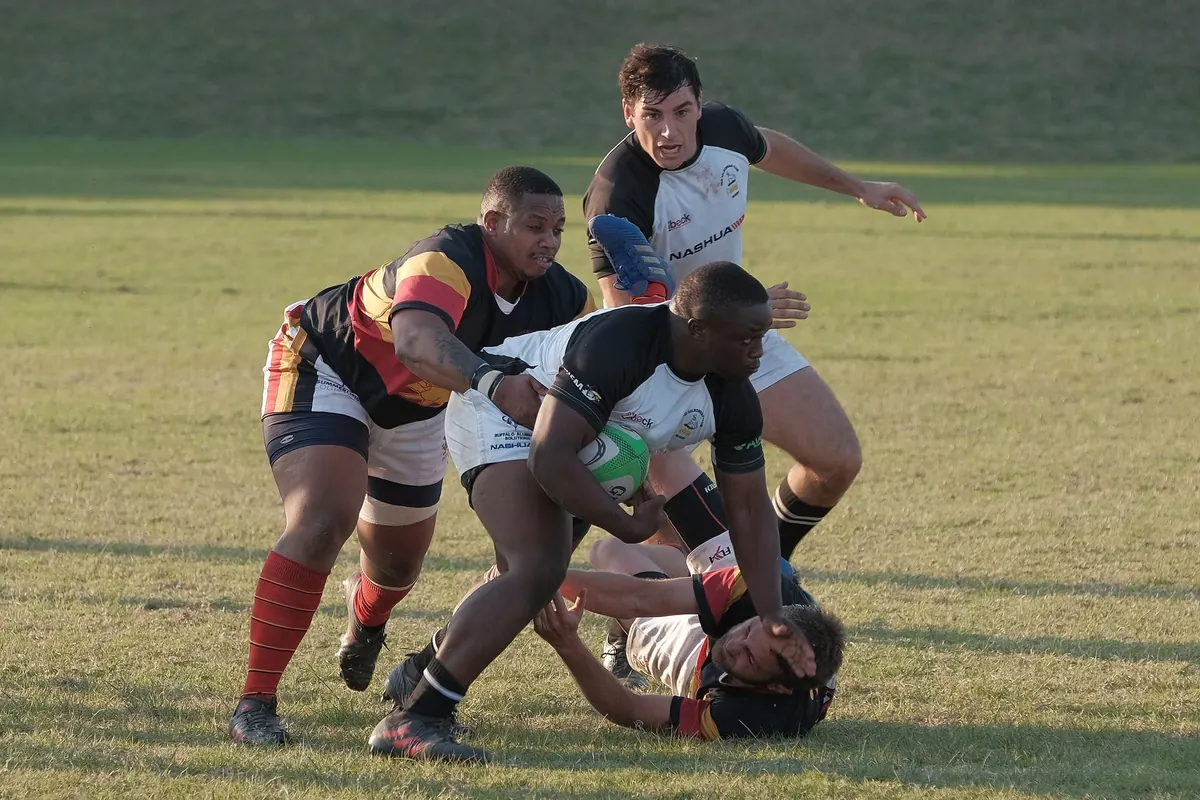
Tackled players must release the ball. When a player is brought to ground, they have to let go so both teams can contest for it. Cling on and you concede a penalty. High tackles, above the shoulders, are penalised strictly too.
A ruck forms over the ball on the ground. Players from both teams stay on their feet, bound together, pushing over it. The ball has to be played out with feet or hands. Join from the side and you are offside.
A maul is a standing version. When the ball carrier is held up but still on their feet, teammates bind around them to drive forward. Defenders try to stop the drive or drag it down.
You will also see lineouts, where the ball is thrown in from touch between two lines of jumpers, and scrums, where the forwards bind and push. Treat them as restarts with structure, not mysteries.
Why the Whistle Keeps Going
Most penalties come from offside, a high tackle, not releasing the ball, or collapsing the ruck or maul. When you hear the whistle, the referee will signal a direction. Learn the arm signals — the high tackle, the offside, the not-releasing — and the game begins to narrate itself.
After a penalty, the team with the ball chooses: kick for three points, kick for territory into the corner for a lineout, or tap and run. Watch the captain's decision. It usually tells you exactly how the match is going.
Tips for Your First Match
- Follow the ball, not the crowd. Beginners lose the play by watching the wrong part of the pitch. Keep your eyes on the ball and the three or four players closest to it.
- Pick a team before kickoff. Having a side to support makes the phases matter.
- Use the crowd. When they roar, something just happened. Look up, then rewind if you missed it.
- Track the scoreboard and the clock. Rugby uses a running clock.
- Accept that you will miss things. Even regular viewers miss a decision. The replays are your friend.
If you can, start with a match on a bigger screen rather than in a packed stadium. You can hear commentary, see replays, and pause when a call confuses you. Club games are scrappier but readable; internationals are crisper and faster. Either works.
Your Next Fifteen Minutes
Pick one match this week. Before kickoff, remind yourself of the four scoring methods. During the game, watch number 10 to see who is controlling play, and check the scoreboard to see whether five points or seven just arrived. When the whistle blows, look at the referee's signal before you look at the crowd.
By the final whistle, you will have followed a full match without needing a glossary. That is the whole trick. Watch three matches with those habits and you will be the person your friends ask to explain what just happened.
Photo: Ollie Craig / Pexels